
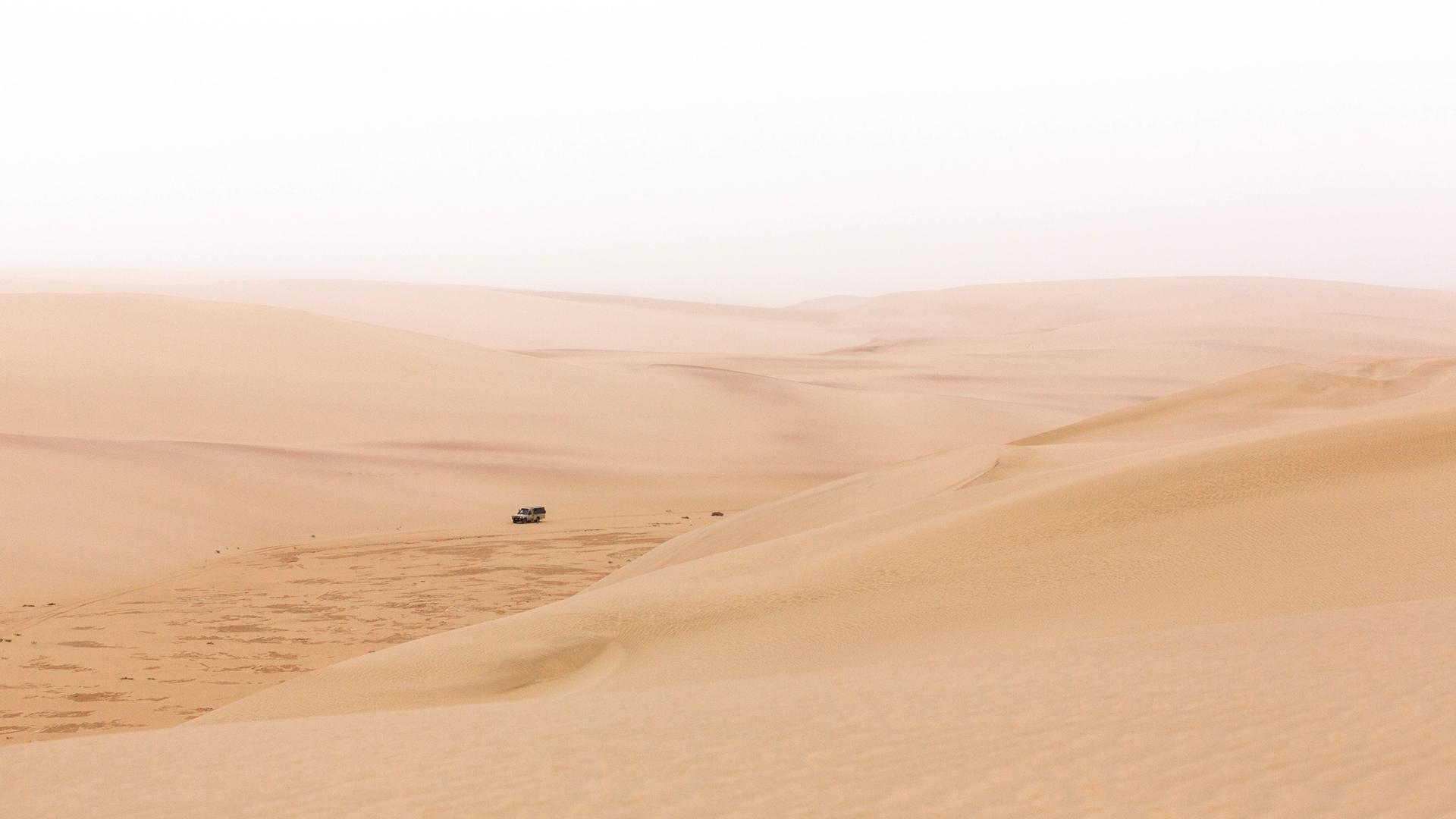
Namibia, Part 2: three excellent lodge options, two sensible routes and the small matter of distance.

Image credit: andBeyond Sossusvlei Desert Lodge.
The Namib from above. Image courtesy of andBeyond Sossusvlei Desert Lodge.
The planning challenge in Namibia is distance. The experiences you have travelled all this way for are spread across an enormous country, connected by long gravel roads and light aircraft. The landscapes between them are part of the story, but crossing them takes time. A full day on the road has its virtues. On a five-night trip, most of them are philosophical. We fly.
The geography has no interest in your schedule
Windhoek to Sossusvlei takes a full day by road or a little over an hour by light aircraft. Continue north towards Damaraland and you face another long day on gravel. The aircraft does something more useful than make the itinerary look grand: it returns the holiday to you.
Three lodges anchor the routes we consider: andBeyond Sossusvlei Desert Lodge in the south, Mowani Mountain Camp in Damaraland, and Wilderness Hoanib Skeleton Coast Camp in the remote north-west. They offer three distinct landscapes, but they are options rather than an instruction to collect the set.
Technically possible is a poor standard for a luxury holiday. With five nights, we choose two bases: two nights at Sossusvlei, followed by three at either Mowani or Hoanib.
Sossusvlei: begin with the sky
andBeyond Sossusvlei Desert Lodge is the natural first stop for the dunes, Deadvlei and the night sky. It has ten suites plus a family Star Dune Suite, with plunge pools, glass walls and retractable skylights above the beds. There is also a working observatory and, when one is on duty, a resident astronomer.
The skylight is not subtle. Happily, neither is the southern sky.
You leave before sunrise for Sossusvlei while the air is still cool and the dunes hold their richest colour. By mid-morning you are back at the lodge with the main expedition complete and the day still available for a nature drive, e-bike, quad bike or guided walk. A good desert guide changes the scale of what you notice. Tracks, beetles and tiny movements begin to fill the ground that looked empty from the vehicle.

Image credit: andBeyond Sossusvlei Desert Lodge.
andBeyond Sossusvlei Desert Lodge. The roof opens above the bed, which feels like the correct response to this sky. Image courtesy of andBeyond Sossusvlei Desert Lodge.
Damaraland: six thousand years in the margins
North of Sossusvlei, high dunes give way to dry riverbeds and rounded red granite. Mowani Mountain Camp fits fifteen rooms among those boulders, with open-air bathrooms and decks where the nearest visual interruption is usually another boulder.
The camp sits close to Twyfelfontein, Namibia's first UNESCO World Heritage Site. More than two thousand engravings have been cut into the sandstone there, with hunter-gatherer activity in the valley stretching back something like six thousand years.
One engraving appears to depict a seal, although the Atlantic is more than a hundred kilometres away. A guide will explain what is known and where archaeology quite properly refuses to guess.
You can explore the engravings with a guide, take a dune drive or follow the dry river courses used by Damaraland's desert-adapted elephants.

Image credit: Mowani Mountain Camp, Chiwani Safari Camps. Photography: Marcus Westberg.
Mowani Mountain Camp. Fifteen rooms, a great deal of granite and very little visual clutter. Image courtesy of Mowani Mountain Camp, Chiwani Safari Camps. Photography by Marcus Westberg.
Hoanib: where safari reaches the Atlantic
Wilderness Hoanib Skeleton Coast Camp has eight solar-powered tented suites beside the Hoanib River in the Kaokoveld. This is remote north-western Namibia, where riverbeds may show no surface water for much of the year and animals travel extraordinary distances to find what they need.
The lions and elephants here are described as desert-adapted, meaning they have learned to range farther and survive with scarcer water and food than their better-watered counterparts.
On stays of three nights or more, Hoanib includes a coastal excursion to Möwe Bay by light aircraft or vehicle, depending on the weather. The Atlantic is cold, the dunes run towards the water and shipwreck remains sit along the shore. The landscape has declined the usual courtesy of a transition.

Image credit: Wilderness Hoanib Skeleton Coast Camp.
Crossing the Skeleton Coast dunes. Image courtesy of Wilderness Hoanib Skeleton Coast Camp.
Five nights means making a choice
If Sossusvlei and the Skeleton Coast are the priorities, the cleanest five-night shape is two nights in the south and three at Hoanib. That protects the coastal day and gives you the greatest contrast: high dunes first, cold Atlantic last.
If rock art, granite country and desert-adapted elephants matter more than the coast, pair two nights at Sossusvlei with three at Mowani. The trip remains varied without turning every second morning into a departure.
To do all three regions properly, we would start at seven nights: two at Sossusvlei, two at Mowani and three at Hoanib. Anything shorter begins to resemble a tour of very well-appointed airstrips.
Luxury is mostly arithmetic here
In Namibia, a charter flight earns its place by removing road days, protecting early starts and letting a five-night trip contain five days of Namibia rather than three visits separated by gravel.
The other luxuries are equally practical: transfers timed around the flying, luggage limits explained before you pack, and enough nights in each place to enjoy the lodge after the early start.
Good planning is usually invisible. In Namibia, you can measure it in hours returned to the day.
We settle the welcome before you land
Before departure, we brief every property in writing with your names, your relationship, the bed configuration and whether the trip marks a honeymoon or anniversary. Direct language prevents a romantic arrival from becoming an administrative exercise.
By the time you reach a camp in the Kaokoveld, the team knows exactly who it is welcoming. You can get on with the considerably more interesting business of being there.

Our Travel Experts, sorting the flying, the sequence and the details that should already be settled when you arrive.
A final note on desert weather
What belongs in your suitcase depends on when you travel, and we will advise you accordingly. During the cooler months, early starts and open vehicles call for a proper jacket, scarf, beanie and closed shoes, even when the afternoon turns warm. In the hotter months, think breathable clothing, reliable sun protection and something light for the evening.
Whatever the season, layers are the clever part: easy to add at half-five, easy to lose by lunch. And yes, leave room for swimwear. A desert lodge with a plunge pool has already made its position clear.
Tell us which Namibia you want most: dunes and coast, or dunes and deep time. Speak to our Travel Experts and we will give the country enough room to behave properly.


