
Namibia, Part 1: the oldest desert on earth and the art of feeling very small.
Five nights, used well
If you are reading this, chances are Namibia has been hovering near the top of your travel list for a while. We understand. It is an adventurer’s paradise, and the temptation is to treat half the map like a tasting menu. With only five nights, though, the best trip is not the one that collects the most stops. It is the one that lets two very different regions make a lasting impression.
Here is how we would use them: two nights at Sossusvlei, followed by three nights at either Mowani in Damaraland or Hoanib towards the Skeleton Coast. Choose one. The northern stay is the second half of your journey, not an invitation to squeeze in a third stop and spend half your holiday admiring Namibia through a car window.

Why Sossusvlei goes first
We begin with Sossusvlei because its red dunes, white clay pans and black camel thorn trees establish the scale immediately. At first light it can feel like a Christopher Nolan film set: monumental, exact and faintly unreal. Sossusvlei is not the whole of Namibia, though. It lies within the Namib in the south-west; farther north, Damaraland turns rockier and Hoanib reaches towards the Skeleton Coast. Starting here gives the rest of the journey something to contrast with.

Three people per square kilometre. Plenty of room.
Namibia sits on the south-western edge of Africa, with the Atlantic Ocean to the west and an enormous interior stretching towards Botswana and South Africa. The 2023 census counted just over three million people across more than 800,000 square kilometres. That works out at roughly three people per square kilometre, making Namibia one of the least densely populated countries on earth. Perhaps even an introvert’s paradise.
The word Namib comes from Nama and means vast place. The name is refreshingly frank.
The Namib has been arid for something in the order of 55 million years, making it the oldest desert on the planet. Oddly enough, one of the forces shaping it is water. UNESCO listed the Namib Sand Sea in 2013 partly because it is the only coastal desert on earth with such extensive dune fields influenced by fog.
The cold Benguela Current runs along the coast and helps send that fog inland overnight. In a landscape where rain is scarce, the moisture is a lifeline. Certain beetles climb the dunes in the early morning and collect droplets on their bodies. The beetles, sensibly, have a system.
From a distance, the Namib can look empty. Up close, beetles like these reveal a landscape where survival depends on making very little go a very long way. Which sounds oddly like the early days of being a student, doesn’t it?

Image credit: andBeyond Sossusvlei Desert Lodge.
The Namib Sand Sea. Fog from the Atlantic is one of the desert's most important water sources. Image courtesy of andBeyond Sossusvlei Desert Lodge - more on that in part two.
A traveller with an excellent comparison set
Not too long ago, we planned a properly adventurous African journey for one of our guests: Rwanda, Cape Town, the Sabi Sand, Victoria Falls and Namibia in a single trip. Yea, be that adventurous, we dare you.
In case you’re not overly familiar with why that’s such a crazy contrast, here’s the tldr. Rwanda brings forested hills and mountain country. Cape Town is a cosmopolitan city on the Atlantic. The Sabi Sand is a private safari reserve connected to South Africa's Kruger National Park. Victoria Falls is one of the largest waterfalls on earth. Namibia then removes most of the water, vegetation and people from the frame. In other words, it’s VERY different.
By the time this guest reached Sossusvlei, their comparison set was pretty educated. They described the desert as feeling "like being on another planet" after all that green. A traveller who has just seen that much of Africa is not easily impressed, which is exactly why mentally pinned that comment.
What the light does out here
Sossusvlei is a basin surrounded by some of the Namib's highest dunes. You leave before sunrise, partly for the cooler air and partly because the early light is to die for. One face of a dune turns orange while the other remains almost black, with a clean ridge between them. The image below does a pretty good job of visualising that fact.
Namibia is very good at making reasonable people pack, well, less reasonably. But, that’s not a bad thing. A winter afternoon at Sossusvlei can sit around 25°C; the night may fall to freezing, but by then you’re already cosying up with something strong. At half five the next morning, even the most composed traveller looks at their weather up with that “this really a desert” kind of expression. Bring layers but also the tight speedo you’ve been dying to flaunt.
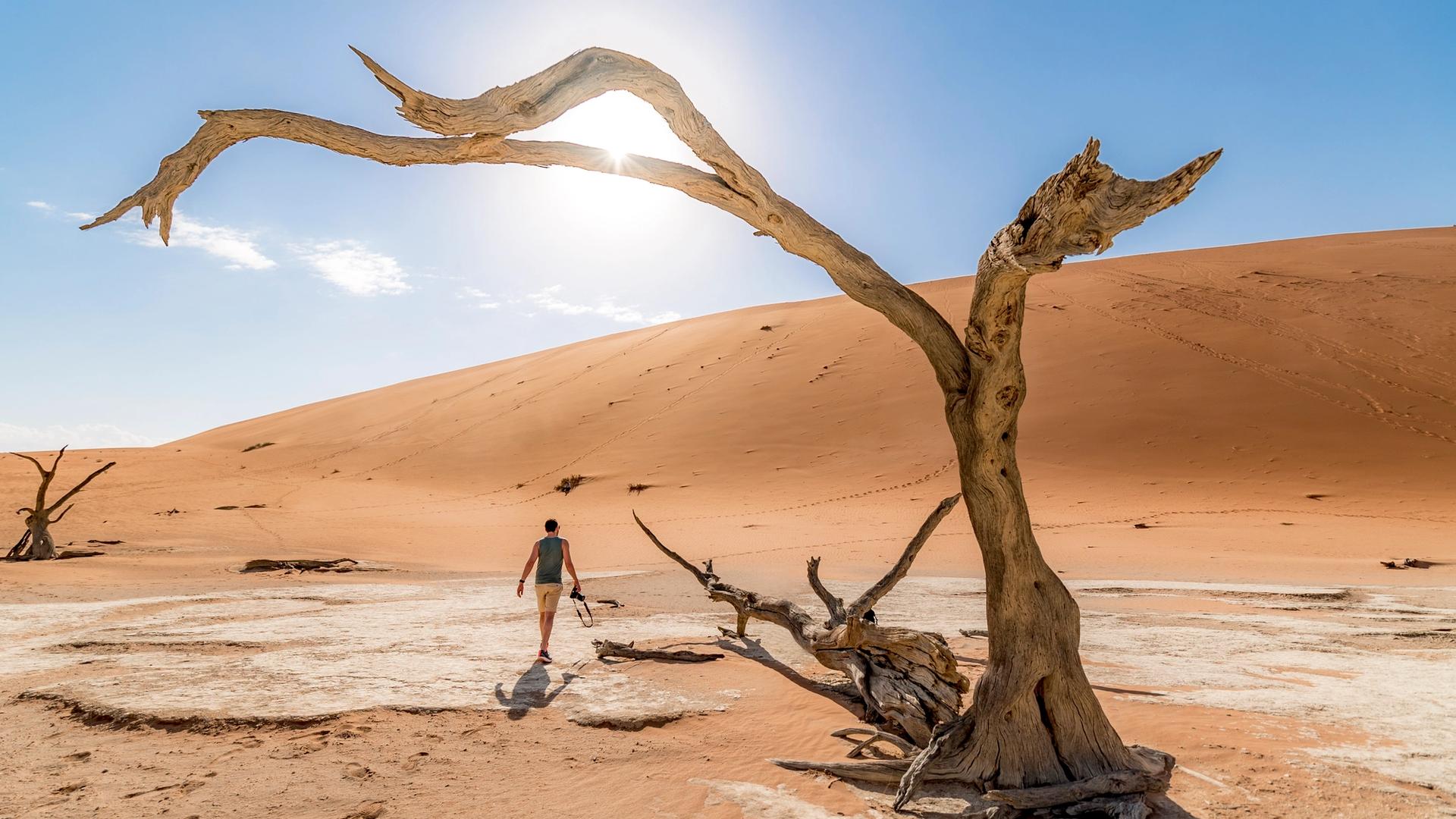
Nearby, Deadvlei is a white clay pan where camel thorn trees that died roughly six to seven hundred years ago are still standing. The air is too dry for the wood to decompose. Black trunks, white ground, orange dunes. It’s pretty much Mad Max Fury Road, just without all of the madness and fury.
Deadvlei. The trees have remained standing for centuries because the desert is too dry for them to rot.
At night, the scale moves overhead. NamibRand Nature Reserve became Africa's first International Dark Sky Reserve in 2012 and received the strictest grade then available.

Image credit: andBeyond Sossusvlei Desert Lodge.
NamibRand after dark. Very little artificial light stands between you and the southern sky. Image courtesy of andBeyond Sossusvlei Desert Lodge.
The successful version assigns its regions carefully and accepts that distance is part of the country rather than a planning error. In Part 2, we get practical about three lodge options, the two routes that make sense in five nights, and why a light aircraft is worth the splurge.
If this feels like your sort of adventure, speak to our Travel Experts. We will make the five nights count.


