
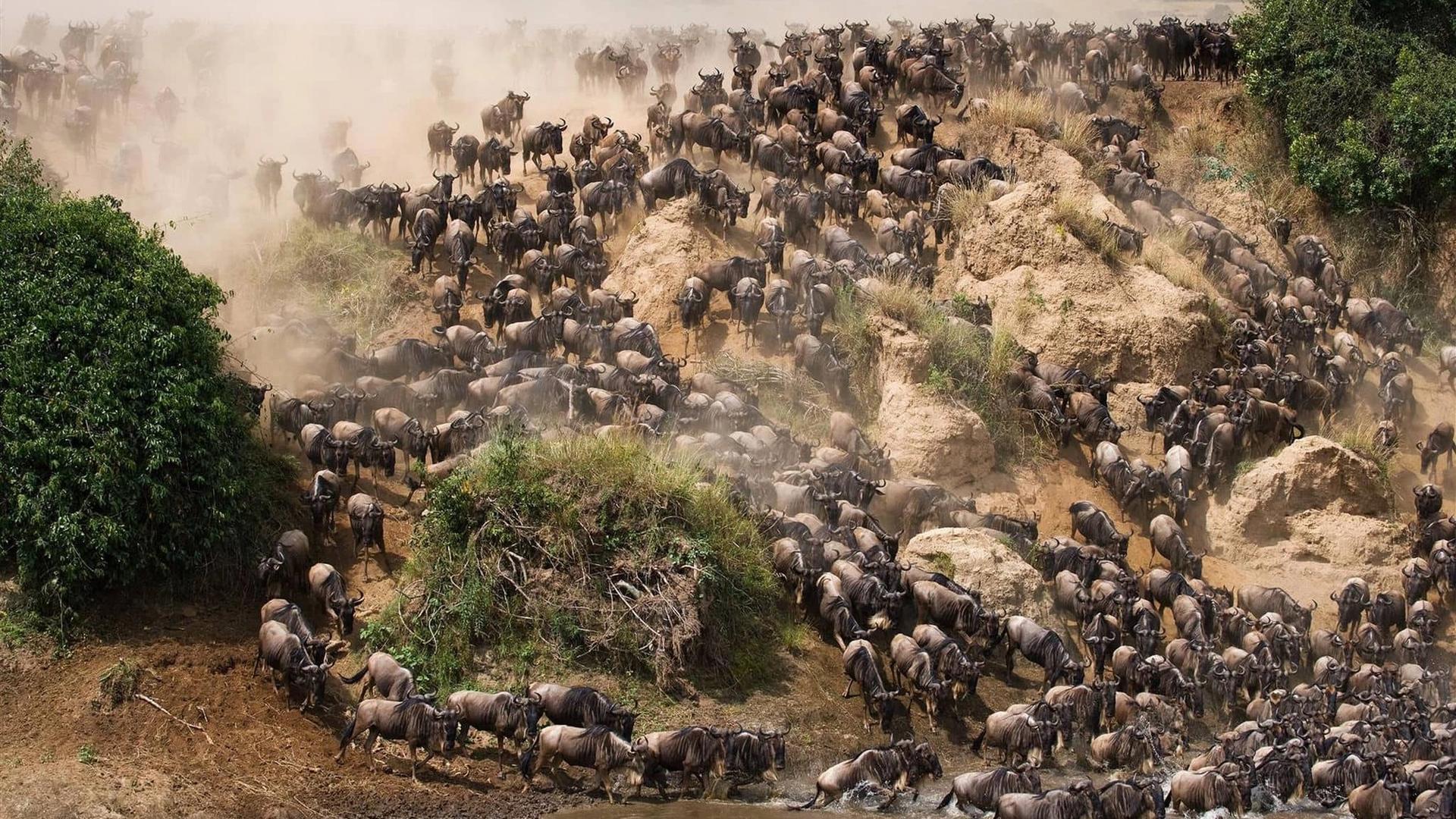
If you’ve always wanted to see the Great Migration in East Africa for your gay-friendly holiday, listen up! Seeing this spectacle takes a little bit of planning because the wildlife do not stay in one place. So, because they’re always on the move, you need to ensure you have the best seats in the house from where to admire them. Here’s where to see the Great Migration in East Africa.
Picture This…
It's the middle of March in northern Tanzania, and thousands of plains game gleefully munch on sweet, tasty Serengeti grass. The female wildebeest have just become mothers, and their calves seem slightly wobbly on their legs at first. However, after a few stumbles and staggering steps, the young offspring are soon prancing like pros. With plenty of food to go around – life seems pretty grand in this neck of the woods. And yet, something in the air stirs – spurring a handful of the herd to start moving. And the rest begin to follow. Just like that, the largest terrestrial mammal movement on earth has begun, namely the Great Migration.

What’s The Great Migration?
Is it panic? A momentary state of mass silliness? No! It's the most fabulous show on earth! The Great Migration is a journey like none other. It's an ever-moving circular trip of around 1,000 kilometres across two countries, Tanzania and Kenya. They traverse across plains where predators – lion, cheetah and leopard – wait in anticipation and with hungry bellies.

After calving in Tanzania's Serengeti near the Ngorongoro Conservation Area, thousands upon thousands of wildebeest are joined by a host of herbivore companions. They venture across vast distances over grasslands and hills, even trudging through crocodile-infested rivers – all while dodging big cats, battling starvation, thirst and fatigue.

There's no set start and finish to this unforgiving parade but rather a clockwise search for greener pastures. Ironically, this circular pilgrimage is somewhat symbolic of the circle of life. Thousands of animals perish due to predators and harsh elements, but thousands more are born and thrive because of it. The Great Migration has followed the same pattern for thousands of years and is, arguably, the most mind-blowing safari experience in Africa.

When is The Best Time to See The Great Migration?
The last thing you want is to arrive in Kenya only to find that the stars of the greatest show on earth have been delayed and are still performing in Tanzania! So, the biggest factor when planning your Great Migration safari is deciding when to go. But, not to worry, here at Out2Africa, we're extraordinarily in tune with the movements of the Great Migration.
It all depends on the rainfall – and we watch the weather like a vulture watches a soon-to-be abandoned carcass! Here's a rough breakdown of where our beloved wildebeest celebrities will be at certain times of the year.

Where to See The Great Migration
The Great Migration in Tanzania
- December to March
Northern Tanzania is the place to be during this time, as massive herds congregate in the Serengeti and Ngorongoro areas. The verdant plains are carpeted with voluptuous vegetation thanks to the annual rains – and the wildebeest love it!
Furthermore, this is considered calving season and is a spectacular time for viewing newborn babies. However, the herbivores are not the only ones feasting, feeling footloose and fancy-free, and big cat sightings (and kills) are also common.

- April to May
From April, the African skies swell with looming clouds, triggering the wildebeest to start moving west and north to the Serengeti's Western Corridor.
However, seasonal downpours make it tricky to follow the masses during this part of their journey. In fact, some of Tanzania's smaller camps shut down due to roads becoming impassable.

- June to July
As the rains subside, our wildebeest rockstars (together with their fabulous zebra entourage) gradually gravitate north. Smaller sporadic groups begin to meet and mingle, resulting in an amalgamation of bigger herds.
Furthermore, the animals are getting raunchy as it's also mating season for the wildebeest. Therefore, during this time, the best place to watch this stage of the Migration unfold is in Western Serengeti.

During this time, the herds will face their first formidable obstacle, the fierce Grumeti River. The Grumeti poses great depths in places, especially if the rains have been bountiful, making drowning a real possibility for many wildebeest. Moreover, plenty of ravenous crocodiles take advantage of the ensuing distress!

The Great Migration in Kenya
- August
The luscious grass of the western Serengeti is starting to lose its appealing plumpness. It starts to look slightly shrivelled, turning from brilliant green to a less-attractive yellow. Therefore, the time has come again to get up and get going.
The herds continue north. Those that survived the Grumeti River crossing continue toward Kenya's Lamai Wedge and the Mara Triangle. But before they can get to the greener pastures of the Mara, they have to overcome another river crossing.

This time it's the world-famous Mara River, and it, too, is crowded with restless crocodiles. Over time, the Mara River crossing has been immortalised by David Attenborough. Documentary after documentary, the migration crossing has been the canvas on which the concept of "survival of the fittest" has been illustrated in its purest form.

- September to November
Chaos reaches its peak during the Mara River crossing. But, by September, the show begins to settle down. The Mara plains are filled to the brim with infinite numbers of wildebeest and grazing groupies. But drama is still pending as predators patrol and take advantage of the remaining "buffet".

Following the East African short rains in late October and early November, the wildebeests appear to have miraculously recovered from the frenzy of migration fever.
Therefore, the tuckered-out antelopes gradually make their way back to Tanzania, dispersing into smaller groups as they venture out into the far reaches of the Serengeti. Once again, the cycle continues as the calving season commences.

The Great Migration in East Africa Awaits
The Great Migration is part jaw-dropping spectacle, part great tragedy. But one thing is certain for those who bear witness – it evokes a variety of emotions from awe to empathy and everything in between.
So, are you ready to book your gay-friendly Great Migration adventure in East Africa? Reach out to one of our East Africa Experts and start planning your Great Migration safari today.


